
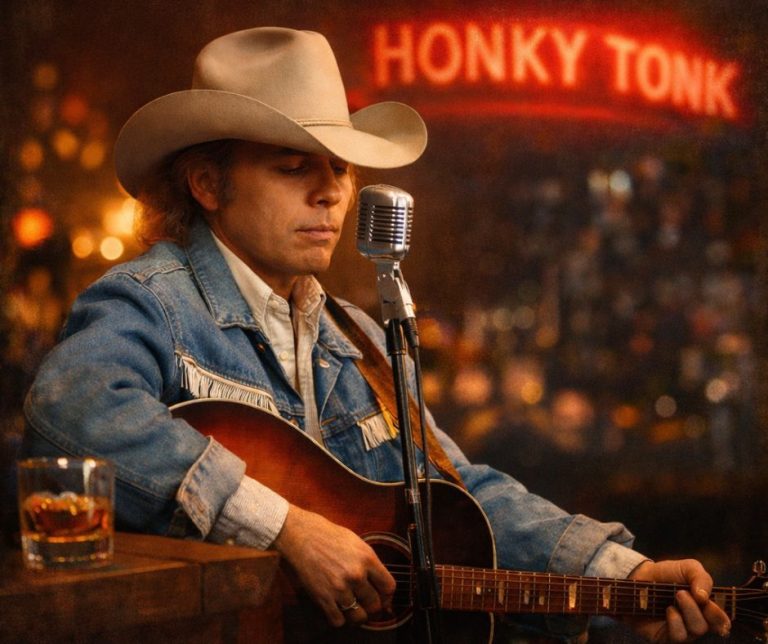
Dwight Yoakam and "Off Your Mind" – When an Old Country Song Becomes a Quiet Confession
In the world of country music, not every song needs to top the charts to become unforgettable. Some songs live quietly in the background of people's lives, returning again and again whenever memories are stirred. "Off Your Mind," as performed by Dwight Yoakam, is one of those songs. It may not always be the most talked-about track in his catalog, but the emotion it carries has allowed it to endure for decades. For many listeners, the song feels less like a performance and more like a quiet confession about a feeling nearly everyone has experienced at some point in life: trying to forget someone who once meant everything, only to realize that forgetting is far more difficult than it sounds.
What many fans don't immediately realize is that "Off Your Mind" was not originally written for Dwight Yoakam. The song was first recorded by Hank Williams, one of the most influential figures in the history of country music. Williams built his legacy on songs that were simple, honest, and emotionally direct, and "Off Your Mind" reflects exactly that spirit. Like many of his compositions, the song relies on a straightforward honky-tonk structure: a steady rhythm, mournful steel guitar, and lyrics that feel almost conversational. Instead of telling an elaborate story, the song focuses on a single emotional truth. A man insists that he is trying to move on from the woman he once loved, yet every moment of his life seems to bring her back into his thoughts. The more he tries to put the past behind him, the more present it becomes.
When Dwight Yoakam began performing the song decades later, he did more than simply revive a classic. His interpretation became part of a larger musical conversation between two generations of country music. Hank Williams represented the early foundation of the genre, the raw emotional honesty that defined country music in the 1940s and 1950s. Dwight Yoakam, on the other hand, emerged in the 1980s as one of the artists determined to bring those traditional sounds back into the spotlight at a time when the genre was becoming increasingly influenced by pop production. By choosing to perform songs like "Off Your Mind," Yoakam was not just honoring a musical hero—he was helping to keep the original spirit of country music alive.
Yoakam's devotion to traditional country sounds has always been central to his identity as an artist. When he first began recording music, Nashville was moving in a more polished and commercial direction, but Yoakam chose a different path. He embraced the twang of honky-tonk guitars, the simplicity of old-school arrangements, and the storytelling style that defined earlier generations of country singers. His breakthrough record, Guitars, Cadillacs, Etc., Etc., proved that audiences were still deeply connected to those traditional roots. The album's success demonstrated that the emotional honesty of classic country music still resonated with listeners, even in a changing musical landscape.
Within that context, songs like "Off Your Mind" fit perfectly into Yoakam's musical world. The track carries the same emotional simplicity that defined Hank Williams' writing, yet Yoakam's distinctive voice gives it a new sense of life and immediacy. When he performs it, the song doesn't feel like a museum piece from the past; instead, it sounds as if it could have been written yesterday. That ability to bridge time is one of the reasons the song continues to resonate with audiences today.
At its core, "Off Your Mind" speaks to a universal experience. The story it tells is remarkably simple, yet deeply relatable. The narrator claims he is trying to forget someone who once occupied his heart. Perhaps he goes out drinking with friends, perhaps he fills his days with distractions, perhaps he convinces himself that time has healed everything. But despite all of those efforts, one realization remains unavoidable: she is still on his mind. Country music has always been powerful because it embraces emotions that many people try to hide. Instead of masking heartbreak with elaborate poetry, songs like this speak directly and honestly about the quiet struggles people face in their everyday lives.
When Dwight Yoakam sings the song on stage, many fans describe a feeling that goes beyond nostalgia. It feels personal, almost as if the singer is telling a story that belongs to everyone in the room. The slow rhythm and melancholy tone give listeners space to reflect on their own memories, their own relationships, and the people they once tried to forget. In that sense, the song becomes more than a piece of music; it becomes a mirror reflecting the emotional experiences of the audience.
Part of what makes "Off Your Mind" so enduring is its simplicity. The song does not rely on dramatic twists or grand storytelling. Instead, it focuses on a quiet truth that most people eventually discover: some memories never fully disappear. They may fade over time, and life may move forward in countless ways, but certain people remain part of who we are. A song, a photograph, or even a passing thought can bring those memories rushing back in an instant.
This is why songs like "Off Your Mind" continue to survive across generations of country music listeners. Long after the charts have changed and musical trends have come and gone, the emotions captured in the song remain just as real as they were when Hank Williams first recorded it. Dwight Yoakam's performances help remind audiences that country music has always been about telling honest stories about real life, even when those stories are quiet and deeply personal.
In the end, "Off Your Mind" is not just a song about trying to forget someone. It is about the way certain people remain part of our lives long after they are gone. It is about memory, longing, and the quiet realization that some emotions cannot be erased simply by wishing them away. Perhaps that is why the song continues to resonate with listeners today. It speaks to something universal, something deeply human. And in the hands of Dwight Yoakam, that simple story becomes a timeless reminder of the emotional power that country music has always carried.